
 As a student in Vienna during the 1971-1972 academic year, I was always looking for ways to save money. Fortunately, Austrians made it possible for students to live cheaply with subsidized eateries (Mensa); cheap student lodging (Studentenheim); reduced prices for museums, plays, opera and concerts; and reduced fares on public transportation. For most of these discounts, all you needed was proof that you were a university student.
In addition, other bargains, available to everyone, were to be found, including the incredibly cheap "standing room" places for even the best music and dance events. With plenty of time to stand in line, I got excellent standing spots to hear the Wiener Philharmonic, observe Leonard Bernstein conduct Mahler symphonies, and watch Nureyev dance.
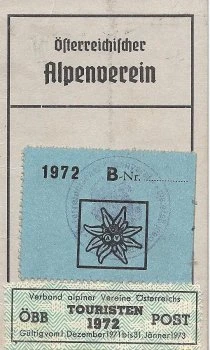
Membership Card for the
Austrian Alpine Club (front)
 Later that day, when I mentioned that I had joined the Ősterreichischer Alpenverein to my friend Jörg Wollmann, a Viennese who was a few years older than me, he gave me a funny look, shook his head, and said something like, "Don't you know that is a brown group."
Well, I didn't know, and I was not sure what he meant. However, I was quite aware of the deep political divisions in Austrian society that had created, from the beginnings of the First Republic after WWI, what political scientists had called "Lager, " roughly translated as "political camps, " into which most people were born and stayed their whole lives.
The two main political camps were the socialists (or social democrats) and the Catholic-conservatives. Membership in the camps was, to a large extent, a matter of geography: most members were grouped together based on where they lived. For example, a large majority of Viennese (excluding those living in a few districts) were solidly members of the socialist camp, while most rural and small city Austrians were members of the Catholic-conservative camp. In industrial cities, the socialists lived in worker's districts, and the Catholic-conservatives lived elsewhere.
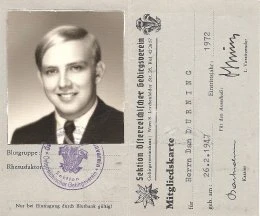
Membership Card for the Austrian Alpine Club (inside)
Also, occupation played a large role in determining to which political camp you belonged. Most laborers ("workers") were in the socialist camp, and most shop owners, farmers, and managers were Catholic conservatives.


